

Bret Pasch: One Mountain, Resounding Impact

Photo of Bret Pacsch handling a Mt. Graham red squirrel.
Photo courtesy of Bret Pasch
Bret Pasch traces his love of nature and interest in teaching back to his childhood in the pine barrens of New Jersey. In his youth, he was introduced to the annual ocean rhythms and a love for music by his father, a fisherman. His mother provided non-toxic nail polish he used to mark turtles to track their movements –a rudimentary version of a study common in wildlife biology.
Such experiences later translated to formal undergraduate research on the outskirts of Philadelphia. Dr. Michael Steele, an expert on tree squirrels at nearby Wilkes University made a lasting impression by introducing Pasch to the field of animal behavior.
“Following a visit to his field site with my advisor, I began marking squirrels around campus and tracking them like I did turtles back home. I was fascinated by animal behavior but never imagined it as a career,” Pasch said.
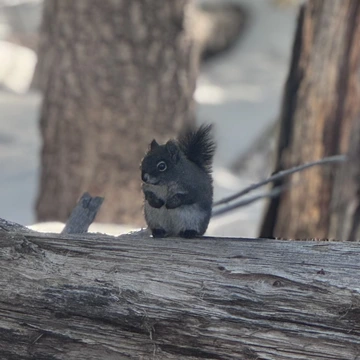
Photo of a Mount Graham red squirrel.
Photo courtesy of August Walser
From a first-generation college student to now an associate professor in the School of Natural Resources and the Environment, Pasch teaches courses in animal behavior, bioacoustics, and conservation. Within the Mount Graham Biology Programs, he and his students continue to explore what small mammals can reveal about the health of an ecosystem.
The lab’s research centers on the Mount Graham Red Squirrel, isolated to the mixed conifer and spruce-fir forest atop the Pinaleño Mountains in southeastern Arizona. Listed as endangered in 1987, the squirrel has persisted through various forest disturbances including anthropogenic interference, severe wildfire, bark beetle infestations, and natural ecological cycles.
Recently, a 2026 article by Pasch and colleagues published in a special feature of the Journal of Mammalogy detailed the role of the Mount Graham Red Squirrel as an indicator of change within the forest.
In this Q & A, Pasch discusses how integrating long-term data on animal behavior and forest ecology with student engagement contributes to wildlife conservation and management in southern Arizona and around the world.
How do the red squirrels and forests of Mt. Graham act as ecological indicators?
Forests are home to most of Earth’s land biodiversity, and, studying one squirrel and its relation to the forest atop a single mountain can tell you about how environmental change might impact all the other animals that rely on forests regionally and globally.
Tree squirrels, in general, are good indicators of a healthy forest. Red squirrels are unique because in many places they harvest and store cones in small micro-environments called middens that preserve cones for meals during times of food scarcity. Some of those cones that they hide, they can’t find again. Lost cones eventually regenerate, basically planting the next wave of the forest.
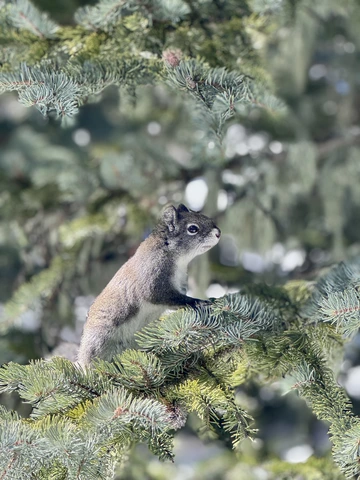
Photo of a Mount Graham red squirrel.
Photo courtesy of August Walser
Red squirrel populations typically lag a year behind food resources and thus provide a window into forest health. The welfare of the forest is reflected in the welfare of squirrels.
"What are squirrels without forest? They're not, they are the forest. That's why we want to conserve habitat. Without forest, squirrels and all other species that rely on it will be lost, including secretive voles, flightless grasshoppers, and numerous understory plants."
- Bret Pasch
Our long-term data indicate that warming temperatures can dry out middens, leading to cone opening and food loss. This negatively impacts the current population and subsequent generations who inherit those middens. Fewer squirrels translates into reduced midden maintenance, resulting in even fewer squirrels.
Moreover, loss of cool, moist microclimate patches may allow wildfires to travel easier through the forest floor, destroying habitat and further reducing red squirrel populations.
In this sense, red squirrels are early indicators of changing forest conditions.
Do you believe the red squirrel is resilient enough to survive future environmental challenges?
I am optimistic. If I'm going to bet on an endangered species, I would choose a species like red squirrels because of their flexibility.

Photo of burned forest disturbance on Mount Graham.
Photo courtesy of Paige Navarrete
They can tolerate tremendous disturbance. At our study site in the nearby White Mountains, red squirrels build middens next to campsites, highways, and recently burned forest. They will bark at you if you get too close to their stash. Red squirrels have saucy temperaments. They embody resilience.
Nevertheless, flexibility can only take red squirrels so far. Given the predictions about changes in climate, we anticipate warmer, drier conditions in the future. A lot of the spruce-fir forest, which we typically associate with higher latitudes, is possibly not going to be supported in the Southwest.
What are squirrels without forest? They're not, they are the forest. That's why we want to conserve habitat. Without forest, squirrels and all other species that rely on it will be lost, including secretive voles, flightless grasshoppers, and numerous understory plants.
There's lots of life that is isolated all throughout the sky islands. There's this beautiful, hidden biodiversity that we are still discovering. These animals have really important connections to the plants and our climate.
What are some future goals for Mount Graham red squirrel research?
We view the mountain as an organism - everything is connected. We are exploring the challenges directly associated with warming conditions, including impacts on red squirrel middens, diet, and foraging-related predation by raptors.
For example, not all red squirrels use larger, isolated middens to store food – a practice called larderhoarding. Where I grew up in New Jersey, red squirrels often “scatterhoard,” distributing their food all about the forest. Other red squirrel populations have transitioned from larderhoarding to scatterhoarding, like one in Baja California, Mexico, where squirrels successfully navigated the transition from a cooler, wetter environment to something that's drier.

Junco eggs in a nest found on Mt. Graham.
Photo courtesy of Paige Navarrete
We’re trying to learn from those populations so that we understand the ingredients needed for a shift like that. I think that's going to be the future of what Mount Graham might look like. Our long-term data on Mt. Graham indicates that red squirrels are creatures of flexible habit. When lots of squirrels are around, they larderhoard more. When fewer are around, they seem to store food in smaller stashes, almost like they are on a path toward scatterhoarding.
Accompanying that change is the question of what else is lost when middens fade? We are finding that birds and arthropods of all kinds are attracted to the middens and may have intimate relations with squirrels.
There’s still so much we don’t know about the connections between all the species that live in places like Mount Graham. So, we’ve started collecting data on small mammal populations across the diverse life zones that characterize sky islands, from desert floor to spruce-fir mountaintop, and monitoring things like the vocal rhythms of squirrels and other forest inhabitants with passive acoustic recorders that sample sound year-round.
How do you approach introducing students to the field of conservation?
The thing that we can do educators and as biologists is bring students to the field and let them see organisms in real life. Conservation is caring, and caring emerges from immersive experiences.
We try to be flexible in offering a diversity of local excursions, including visiting bats under bridges and at a newly developed wildlife preserve and field school. Because many of our students aspire toward careers outside of academia, we also participate in interagency surveys where students work alongside land managers from NGOs and state and federal agencies.
"Not every student will end up in biology or natural resources, but exposure facilitates critical thinking and lasting empathy for our natural world and heritage."
- Bret Pasch
Something powerful happens when people hold animals and look them in the eye that can't be recreated any other way. I can tell you about a desert grassland or a spruce-fir forest, but when you go there and you feel the change in the air and experience the sights, sounds, and smells that define a particular ecosystem, that creates a kind of a mental mark that enriches the information that we're learning about in class.

Photo of landscape view from Mount Graham.
Photo courtesy of Bret Pasch
I also recognize that it’s challenging for students to take time away during strained economic times when they often work part-time jobs. Collectively, we need to increase support for these experiences to a diverse student body. Not every student will end up in biology or natural resources, but exposure facilitates critical thinking and lasting empathy for our natural world and heritage.
How does your work apply to students outside of the field of conservation?
I enjoy science, but I don't think that it's the answer to all of our most pressing challenges. I find a lot of inspiration from music and the arts, and that can inform the science that we do.
As a graduate student, I took a class where I went to the tropics, and there I started merging my interest in music and sound with my interest in animals. The first thing I recorded were juvenile crocodiles, up to my hips in water. Now, I find myself working with bioacoustics and rodent ecology.
We hope to inspire and develop students to take all kinds of classes — philosophy classes and art classes and science classes — so that no matter where you end up, you have an appreciation for the diversity of ways of knowing and seeing. Plus, through local learning and work we aspire to provide an example of how appreciation for a single mountain can grow to have impact beyond Arizona.
What is the long-term impact of the research you do today?
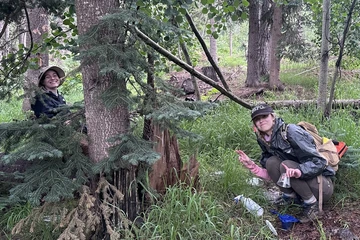
Photo of Mount Graham Biology Programs students, Nikki Reck and Ellie Tierney, conducting field work on Mount Graham.
Photo courtesy of Bret Pasch
There's a great need for long-term data and monitoring. Every data point becomes more valuable with time.
Part of our impact is the “boots on the ground” field work that we do to build upon the legacy of those who came before us. Another part is establishing new baselines for future generations to make discoveries unforeseen by us.
Long-term field studies are hard to get funding for but provide unique insight into the factors that shape populations. We're trying to maintain those resources that were passed down to us. Our recent paper that we’ve published integrates some of that long-term data.
I have the best job in the world. I feel privileged to conduct research that we’re doing, teach classes that I am passionate about, and help train the next generation of students.
To learn more about additional efforts associated with the recovery of the Mount Graham Red Squirrel, explore the Phoenix Zoo captive breeding program and biobanking at the San Diego Zoo.